DATA GOVERNANCE
Numbers your whole team can agree on.
Molsaro resolves every brand, SKU and customer to one canonical record, defines every metric once, and checks the data before it answers. The forecast, the simulation and the chat answer all describe the same business — because they read from the same place.
What were value sales for Choco Crunch last quarter?
WITHOUT GOVERNED DEFINITIONS
Finance
£2.41m
Sales
£2.55m
Marketing
£2.38m
ONE GOVERNED DEFINITION
value_sales
Canonical
ONE ANSWER, EVERY TIME
£2.41m
value sales · Q3 FY26 · 14 SKUs · 6 retailers
Anchored to the last closed month
Scope from the entity master
14 checks green on the load
Traceable to warehouse load 2471
101
governed metric definitions, each with a formula and a unit
14
data-quality checks run against every load
15
readiness probes before the platform serves an organisation
365
days of administrative audit history, retained uniformly

HOW IT FITS TOGETHER
Every number passes through one governed layer.
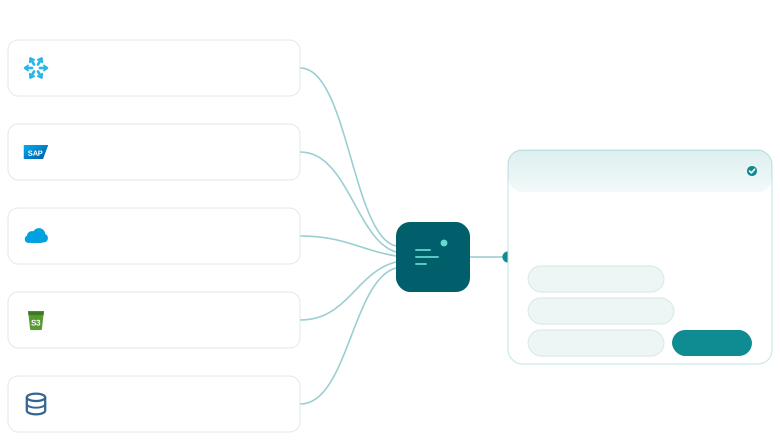
Molsaro sits on top of the systems you already run. Between your warehouse and the number on the screen, five things get settled, and they get settled the same way every time.
SOURCES
Snowflake
Databricks
BigQuery
SAP S/4HANA
Salesforce
Amazon S3
Azure
Oracle Fusion
Cloud Storage
Postgres
IDENTITY
Identifier crosswalk
Canonical entity
Hierarchy
Ownership
Market scope
SEMANTICS
Formula
Unit
Owning layer
Lifecycle
Aliases
101 definitions
PERIOD
Latest closed period
Fiscal calendar and 4-4-5
Granularity guard
QUALITY
14 checks
Freshness sweep
15 readiness probes
Support level
ACCESS
Row-level isolation
Role-aware reads
Agents inherit
Audit trail
WHAT REACHES YOU
A number, with the definition behind it, the entities it covers, the period it belongs to, the checks that were green when it was computed, and the load it came from.
ENTITY RESOLUTION
One product. Five systems. One record.
Your warehouse calls it SKU_88213. SAP calls it MAT-000088213. The retailer sends a barcode. The panel provider abbreviates it. The entity master is where that stops being your problem.
Canonical identifiers. Platform-allocated, not names or codes — a retailer renaming a listing does not fork your history.
Real hierarchies. Corporation to brand to SKU, with ownership propagating down, so “our portfolio” means the same set in every query.
Market scope, not taxonomy. Competitive sets resolve by market and period, kept separate from product classification.

Metric definition
CANONICAL
value_sales
Value sales
Calculation
Direct, summed over the resolved scope
Unit
Organisation currency
Owning layer
Commercial metrics
Also answers to
revenue / sales value / turnover
Granularity guard
Aggregation requires an explicit period granularity
METRIC REGISTRY
Every metric has a formula and an owner.
This is why two teams asking about revenue get the same figure. Definitions live in the database, not in dashboards, so changing one changes it everywhere, once, deliberately.
101 definitions in the catalogue. Volume, value, price, promotion, distribution, margin and share.
An owning layer per metric. Commercial metrics, finance engine, forecasting, demand model — so it is clear which system defines it.
Aliases that resolve. “Revenue”, “turnover” and “net sales” reach the same definition instead of three near-misses.
Your own metrics, governed the same way. Organisation-specific definitions extend the catalogue and inherit the same contract.
DATA QUALITY
See the state of the data before you trust the answer.
Checks run against every load and on a schedule after it. Nothing hides behind a green tick: you see which check failed, what it means, and where to fix it.
Freshness is tracked, not assumed. A staleness sweep watches source loads, the demand model and the forecast.
Readiness is a gate, not a badge. Fifteen probes decide whether the platform is ready to serve.
Counts fail closed. A check that cannot run reports unknown, never zero.
SKU coverage
Passed
Entity completeness
Passed
Price completeness
Passed
Negative values
Passed
Period continuity
2 gaps in one channel
Duplicate detection
Passed
Zero-volume SKUs
Passed
ASP sanity
Passed
Promo completeness
Mechanics missing on 3 retailers
Nest coverage
Passed
Ownership propagation
Passed
Relationship coverage
Passed
Demand model freshness
Trained this month
Forecast freshness
Rebuilt on last close
LINEAGE
Trace any number back to the load that produced it.
When someone challenges a figure in a review, the answer is not that the system said so.
THE NUMBER
-1.4 margin points
Premium tier, last quarter, all retailers
THE DEFINITION
gross_margin_pct
Canonical, owned by the finance engine
THE SCOPE
14 SKUs, 6 retailers
Resolved from the entity master
THE PERIOD
Q3, fiscal 4-4-5
Anchored to the last closed period
THE SOURCE
Warehouse load 2471
14 checks, 1 warning recorded
ACCESS AND ISOLATION
Everyone sees the business. Nobody sees more than they should.
Isolation is enforced in the database, not in the interface. A query that forgets to filter by organisation returns nothing rather than someone else’s data.
Row-level isolation per organisation. Enforced on every tenant-scoped table, with the organisation taken from the session.
Role-aware reads. Member and administrator surfaces differ, and model internals stay on the administrator side of the line.
Agents inherit, never escalate. An agent runs inside the permissions of the person who commissioned it.
ONE PLATFORM, SEPARATED AT THE ROW
Organisation A
Your organisation
Organisation C
Row-level
enforced on every read and write
365 days
administrative audit history
Complete
tenant removal on offboarding
ADMINISTRATIVE ACTIVITY, AS RECORDED
Metric definition changed
Member role changed
Connector credentials rotated
Forecast run accepted
WHAT IT POWERS
Better data. Better decisions.
Governance is not a side feature. It is the thing every engine on the platform reads from.
Attribution
Forecasting
Simulation
Molsaro AI
Agents and automation
Reporting and export

1
source of truth
CUSTOMER LOGO
Space reserved for a named customer quote about agreeing on one set of numbers across commercial, finance and supply.
Name, role
Company
Placeholder — no customer quote, logo or photograph is on file for this page yet. Nothing here is attributed to a real person or company.
Bring us the number nobody agrees on.
Most teams have one — a figure two departments compute differently. Bring it to the demo and we will show you where the definitions diverge, and what it looks like once they don’t.
QUESTIONS
Frequently asked questions
Where does the definition of a metric actually live?
In the platform metric registry, in the database. Definitions load per organisation and cache per request, with a built-in catalogue as the fallback. Dashboards and chat read the registry; they do not carry their own copy of the logic.
Can we keep our own metric definitions and hierarchies?
Yes. Organisation-specific metrics extend the catalogue and inherit the same contract: formula, unit, owning layer, lifecycle. Entity hierarchies and fiscal calendars are configured per organisation.
How is our data separated from other customers?
Row-level isolation on every tenant-scoped table, with the organisation taken from the authenticated session rather than the request. High-volume tables are additionally partitioned by organisation. Offboarding removes a tenant's data in full.
What do agents have access to?
Exactly what the person who commissioned them can see. Agents are published with an approved set of knowledge, tools and outputs, and organisation-authored agents are restricted to read-only tools.
How long is data retained?
Retention is defined in code and applied on a schedule, uniformly across tenants rather than as a per-customer setting. Privacy-sensitive records have the shortest windows; administrative audit history is kept for a year.
Which systems can you connect to?
Warehouses and lakehouses, cloud object storage, transactional databases, enterprise suites, file drops and document sources. The connector list and what each one supports are on the integrations page.